


 Cart
Cart
 sales@molnova.com



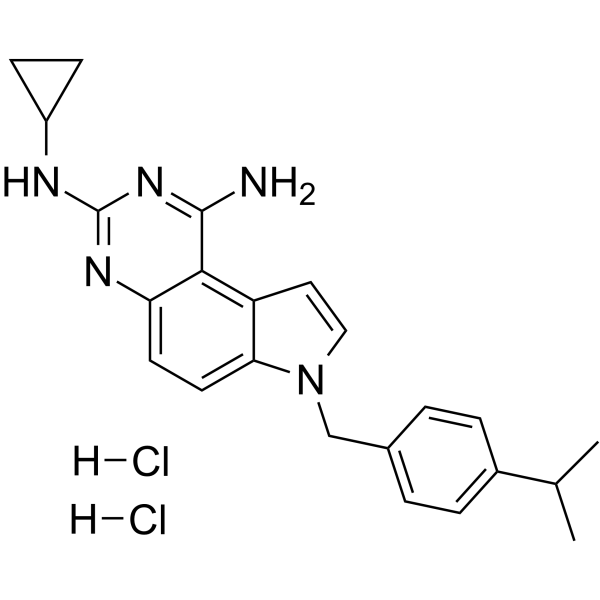
SCH79797 dihydrochloride
CAS No. 1216720-69-2
SCH79797 dihydrochloride( —— )
Catalog No. M26436 CAS No. 1216720-69-2
SCH79797 dihydrochloride is an effective and selective antagonist of protease activated receptor 1 (PAR1) with an IC50 of 70 nM and a Ki of 35 nM.
Purity : >98% (HPLC)
 COA
Datasheet
HNMR
HPLC
MSDS
Handing Instructions
COA
Datasheet
HNMR
HPLC
MSDS
Handing Instructions
| Size | Price / USD | Stock | Quantity |
| 5MG | 115 | Get Quote |


|
| 10MG | 177 | Get Quote |
|
| 25MG | 357 | Get Quote |
|
| 50MG | 557 | Get Quote |
|
| 100MG | 791 | Get Quote |
|
| 200MG | Get Quote | Get Quote |
|
| 500MG | Get Quote | Get Quote |
|
| 1G | Get Quote | Get Quote |
|
Biological Information
-
Product NameSCH79797 dihydrochloride
-
NoteResearch use only, not for human use.
-
Brief DescriptionSCH79797 dihydrochloride is an effective and selective antagonist of protease activated receptor 1 (PAR1) with an IC50 of 70 nM and a Ki of 35 nM.
-
DescriptionSCH79797 dihydrochloride is an effective and selective antagonist of protease activated receptor 1 (PAR1) with an IC50 of 70 nM and a Ki of 35 nM. SCH79797 dihydrochloride has antiproliferative and pro-apoptotic effects.(In Vitro):SCH79797 dihydrochloride inhibits thrombin-induced platelet aggregation with an IC50 of 3 μM. In NIH 3T3 cells, SCH79797 dihydrochloride inhibits serum-stimulated activation of p44/p42 mitogen-activated protein kinases (MAPK) at low concentrations and induces apoptosis at higher concentrations. SCH79797 dihydrochloride inhibits high-affinity thrombin receptor-activating peptide ([3H]haTRAP) binding in a competitive manner. SCH79797 dihydrochloride inhibits α-thrombin- and haTRAP-induced aggregation of human platelets. Thrombin produces transient increases in cytosolic free Ca2+ concentration ([Ca2+]i) in hCASMC. SCH79797 dihydrochloride effectively inhibits this increase in [Ca2+]i. SCH79797 dihydrochloride completely inhibits Thrombin- and TK-stimulated [3H]thymidine incorporation . (In Vivo):In male Sprague Dawley rats, SCH79797 dihydrochloride (2.5 μg/kg, 10 μg/kg, 25 μg/kg, 50 μg/kg, 100 μg/kg, and 250 μg/kg; i.v.) reduces myocardial necrosis following I/R in the intact rat heart in two rat models of myocardial ischemia/reperfusion (I/R) injury immediately before or during ischemia.
-
In VitroSCH79797 inhibits high-affinity thrombin receptor-activating peptide ([3H]haTRAP) binding in a competitive manner. SCH79797 inhibits α-thrombin- and haTRAP-induced aggregation of human platelets, but does not inhibit human platelet aggregation induced by the tethered ligand agonist for protease-activated receptor-4 (PAR-4), γ-thrombin, ADP, or collagen. Thrombin produces transient increases in cytosolic free Ca2+ concentration ([Ca2+]i) in hCASMC. SCH79797 effectively inhibits this increase in [Ca2+]i. SCH79797 completely inhibits Thrombin- and TK-stimulated [3H]thymidine incorporation .SCH79797 is able to interfere with the growth of several human and mouse cell lines, in a concentration-dependent manner. The ED50 for growth inhibition iss 75 nM, 81 nM and 116 nM for NIH 3T3, HEK 293 and A375 cells, respectively. In NIH 3T3 cells, SCH79797 inhibits serum-stimulated activation of p44/p42 mitogen-activated protein kinases (MAPK) at low concentrations and induces apoptosis at higher concentrations.
-
In VivoSCH79797 (2.5-250 μg/kg; intravenous injection; male Sprague Dawley rats) treatment immediately before or during ischemia reduces myocardial necrosis following I/R in the intact rat heart in two rat models of myocardial ischemia/reperfusion (I/R) injury. This response is dose-dependent with the optimal dose being 25 μg/kg. Animal Model:Male Sprague Dawley rats (8 weeks of age) with myocardial I/R injury Dosage:2.5 μg/kg, 10 μg/kg, 25 μg/kg, 50 μg/kg, 100 μg/kg, and 250 μg/kg Administration:Intravenous injection Result:Immediately before or during ischemia reduced myocardial necrosis following I/R in the intact rat heart.
-
Synonyms——
-
PathwayApoptosis
-
TargetApoptosis
-
RecptorHCV
-
Research Area——
-
Indication——
Chemical Information
-
CAS Number1216720-69-2
-
Formula Weight444.4
-
Molecular FormulaC23H27Cl2N5
-
Purity>98% (HPLC)
-
SolubilityIn Vitro:?DMSO : 22 mg/mL (49.50 mM)
-
SMILESCl.Cl.CC(C)c1ccc(Cn2ccc3c2ccc2nc(NC4CC4)nc(N)c32)cc1
-
Chemical Name——
Shipping & Storage Information
-
Storage(-20℃)
-
ShippingWith Ice Pack
-
Stability≥ 2 years
Reference
1.Baker MM, Hammad SF, Belal TS. Development and validation of a versatile HPLC-DAD method for simultaneous determination of the antiviral drugs daclatasvir, ledipasvir, sofosbuvir and ribavirin in presence of seven potential impurities. Application to assay of dosage forms and dissolution studies. Drug Dev Ind Pharm. 2019 Jul;45(7):1111-1119.
molnova catalog



related products
-
GUT-70
GUT-70 is a tricyclic coumarin derived from Calophyllum brasiliense, markedly reduces cell proliferation.
-
Triglycidyl isocyanu...
Triglycidyl isocyanurate is a triazene triepoxide with antineoplastic and antiangiogenic activity. It inhibits growth of human non-small cell lung cancer cells by activating p53. Triglycidyl isocyanurate alkylates and cross-links DNA, thereby inhibiting DNA replication. It induces cell apoptosis and can be used for cancer research.
-
Oxypeucedanin
Oxypeucedanin has novel anticancer effect, mediated via induction of G2-M cell cycle arrest and apoptosis in human prostate carcinoma DU145 cells.
